Kickstart Your Creativity: Simple Drawing Ideas for Beginners
Looking for easy drawing ideas for beginners? You're in the right place. This list provides nine simple drawing prompts, perfect for anyone wanting to pick up a pencil and start creating. Whether your goal is to develop fundamental drawing skills or simply enjoy a relaxing pastime, these ideas offer a clear starting point.
Drawing is a valuable skill, offering a creative outlet and a way to express yourself. These beginner-friendly prompts break down seemingly complex subjects into manageable steps. They cover a variety of categories, from still life and landscapes to animals and character sketches. Each prompt includes a brief description and a helpful tip to get you started. We'll also introduce you to Drawing List, an AI-powered drawing idea generator for endless inspiration.
1. Basic Shapes and Forms
Mastering basic shapes and forms is the bedrock of drawing, a fundamental skill crucial for beginners. This foundational element involves understanding and replicating simple geometric shapes like circles, squares, triangles, and cylinders. By practicing these building blocks, you cultivate essential skills such as proportion, perspective, and form recognition, paving the way for more complex drawings. These skills will be indispensable as you progress to more intricate subjects, from still life to portraiture.

Examples and Implementation
Think of any complex object - a car, a house, a human figure. Each can be broken down into a combination of these simple forms. By understanding the underlying structure, you can more accurately represent the object on paper. Examples of applying this technique include:
- Drawing perfect circles freehand develops muscle control and precision.
- Creating 3D cubes with proper perspective helps grasp spatial relationships.
- Shading spheres to depict light and shadow introduces the concept of form.
- Combining shapes to construct simple objects enhances compositional skills.
Actionable Tips for Practice
Consistent practice is key to improvement. Dedicate just 10-15 minutes daily to honing your skills with these fundamental shapes. Start with light pressure to maintain control and avoid etching mistakes into the paper. Focus on smooth, confident strokes rather than hesitant scratches. Practice drawing the shapes from different angles to understand their three-dimensional nature.
- Use guidelines and construction lines to ensure accuracy and symmetry, especially when starting.
- Gradually transition to sketching without these aids as your confidence grows.
- Try drawing everyday objects around you and breaking them down into their basic shapes. This translates abstract practice into real-world application.
This approach, popularized by artists and educators like Betty Edwards ("Drawing on the Right Side of the Brain") and Andrew Loomis ("Figure Drawing for All It's Worth"), is a cornerstone of traditional art academies worldwide. It's a tried and true method that provides a solid foundation for drawing anything you can imagine, making it a must-have on this list of drawing ideas for beginners.
2. Still Life Drawing
Still life drawing, a cornerstone of artistic training, involves depicting inanimate objects arranged in a composition. This practice offers beginners a fantastic way to hone fundamental drawing skills. By focusing on stationary subjects like fruits, flowers, or household items, you develop keen observation skills, learn to render textures and forms, and grasp the principles of composition and light. These skills translate seamlessly to other drawing genres, making still life an essential step for aspiring artists.

Examples and Implementation
Consider arranging a simple still life with a few everyday objects. A bowl of fruit with contrasting colors and textures, a single flower in a vase, or a collection of kitchen utensils can provide compelling subjects. Even textured objects like pinecones or shells offer excellent practice for rendering detail. Learn more about Still Life Drawing at this helpful resource. By carefully observing and drawing these arrangements, you'll cultivate essential skills for drawing ideas for beginners.
- Drawing a simple ceramic mug focuses on form and shadow.
- Depicting a textured piece of fruit helps understand how to represent different surfaces.
- Arranging multiple objects introduces composition and spatial relationships.
- Using dramatic lighting enhances the interplay of light and shadow, adding depth and interest.
Actionable Tips for Practice
Begin with single, simple objects and gradually introduce more complex arrangements. Use strong directional lighting to create clear light and dark areas. Squinting your eyes helps simplify the scene and identify these major tonal values. Work from light to dark, gradually building up tones and textures. Regular breaks allow you to return to your drawing with fresh eyes and a renewed perspective.
- Start with light outlines and gradually build up details.
- Practice shading techniques to represent different textures and materials.
- Experiment with various compositions to find visually appealing arrangements.
- Focus on accuracy in proportions and relationships between objects.
This classical approach, embraced by masters like Giorgio Morandi, Paul Cézanne, and Chardin, continues to be a valuable teaching tool for drawing ideas for beginners. Its emphasis on observation, form, and composition solidifies core skills, preparing you to tackle more complex drawing challenges with confidence.
3. Simple Landscape Sketches
Mastering simple landscape sketches is a fantastic way for beginners to develop fundamental drawing skills while connecting with the beauty of the natural world. This approach focuses on depicting outdoor scenes using basic elements like horizon lines, simple trees, clouds, and uncomplicated terrain. By practicing these core components, you cultivate an understanding of perspective, depth, and atmospheric effects, essential skills for any aspiring artist. These foundational elements pave the way for more complex landscape drawings and paintings as your skills progress.

Examples and Implementation
Consider the basic building blocks of any landscape: the horizon, landforms, and sky. These elements can be combined and manipulated to create diverse scenes. Examples include drawing simple mountain silhouettes against a vibrant sunset, sketching a basic tree line with interesting foreground elements like rocks or flowers, depicting rolling hills with varying cloud formations, or capturing the tranquility of a simple lakeside scene. Learn more about Simple Landscape Sketches here.
Actionable Tips for Practice
Start with simple horizon line compositions to establish a sense of depth. Employ the rule of thirds for placing key elements within the frame to create visually appealing arrangements. Remember to keep distant objects lighter and less detailed to simulate atmospheric perspective. Practice sketching different cloud shapes separately to develop a repertoire of textures and forms. Working from photos initially can be helpful before venturing into plein air sketching, allowing you to focus on the fundamental elements without the pressure of a changing scene.
- Use a light touch when sketching initial outlines.
- Gradually build up details and shading.
- Focus on capturing the overall essence of the scene rather than minute details.
- Experiment with different perspectives and viewpoints.
This focus on simplified forms, popularized by landscape painting pioneers like John Constable and Romantic masters like Caspar David Friedrich, and revitalized by the contemporary urban sketching movement, is an effective and accessible approach for beginners. It offers a strong foundation in drawing ideas for beginners and enables you to capture the essence of nature's beauty on paper.
4. Basic Portrait Features
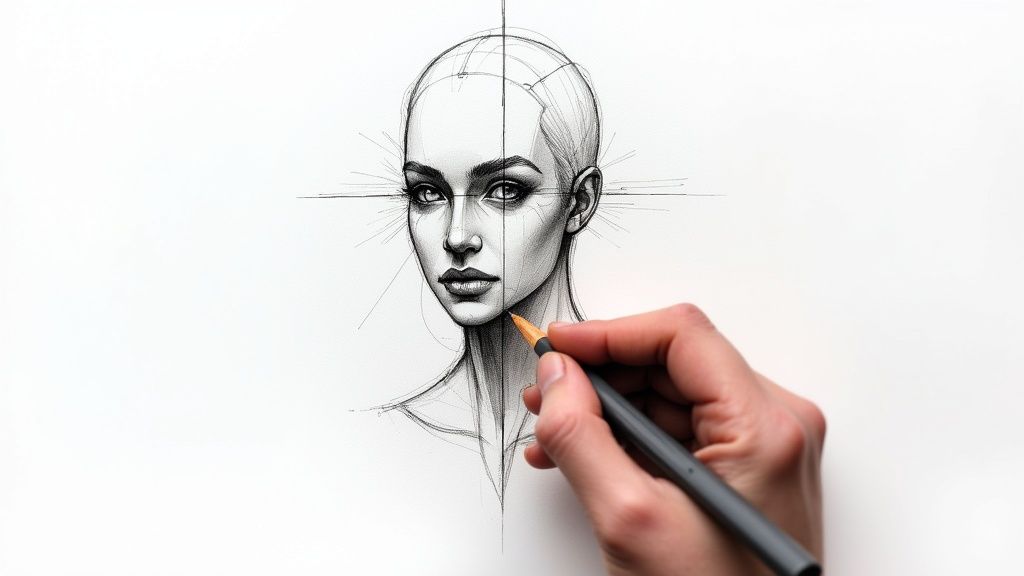
Mastering portraiture can seem daunting for beginners, but breaking down the face into its individual components simplifies the process. Focusing on basic portrait features like eyes, noses, mouths, and ears individually builds a solid foundation for drawing realistic and expressive faces. This systematic approach allows beginners to understand the underlying structure of each feature, improving accuracy and observation skills crucial for drawing ideas. It promotes understanding facial anatomy and proportions, paving the way for more complete and compelling portrait work. These skills will be essential as you transition to full portraits, caricatures, and figure drawing.

Examples and Implementation
Consider the diverse shapes and characteristics of each facial feature. Eyes can be almond-shaped, round, or hooded. Noses can be long and narrow, short and wide, or hooked. Mouths express a wide range of emotions through the subtle curve of the lips. Ears, often overlooked, present a complex structure of cartilage and folds. Examples of implementing this technique include:
- Drawing individual eyes from different angles, paying attention to the shape of the eyelids and the position of the pupil.
- Sketching noses in various lighting conditions, observing how light and shadow define the bridge and nostrils.
- Practicing drawing mouths expressing different emotions, focusing on the shape of the lips and the lines around them.
- Studying ear anatomy from a profile view, understanding the placement of the helix, tragus, and lobule.
Actionable Tips for Practice
Regular practice with individual features is key to improvement. Dedicate time each day to sketching these elements. Start with light strokes, focusing on accuracy and form before adding detail. Use a mirror to study your own features or use photo references for diverse examples.
- Use guidelines to ensure the correct placement and proportions of each feature.
- Practice drawing features from different angles and perspectives to develop a three-dimensional understanding.
- Try sketching features from different ethnic backgrounds to broaden your understanding of facial variations.
This analytical approach, employed by artists like Leonardo da Vinci through his anatomical studies, forms a basis for accurate and expressive portraiture. This method, alongside the structured practice offered by Bargue plates and the dynamic figure drawing of Burne Hogarth, strengthens observation skills and translates directly to improved drawing ideas for beginners. It ensures a solid foundation for any artist aspiring to capture the human face on paper.
5. Animal Sketches
Developing your drawing skills by sketching animals is a fantastic approach for beginners. This method focuses on simplifying complex forms into basic shapes, understanding proportions, and capturing characteristic features. Starting with familiar animals, like pets or common farm animals, allows beginners to build a foundational understanding of animal anatomy and movement. This practice provides a solid base for progressing to more detailed animal drawings and wildlife art later.
Examples and Implementation
Consider how a simple oval can represent a cat's curled body or how a series of circles and ovals can form the basis of a dog's head. This technique helps break down overwhelming details into manageable components. Some helpful examples include:
- Drawing a sleeping cat in simplified poses.
- Creating dog head studies focusing on different breeds.
- Sketching basic bird shapes and proportions.
- Depicting simplified forms of farm animals like cows or horses.
Actionable Tips for Practice
Regular observation is crucial for accurately representing animals. Spend time watching your pets or visiting a farm or zoo. Quick gesture sketches are excellent for capturing movement and posture.
- Start with sleeping or resting animals to practice stationary poses.
- Construct the animal's body using basic shapes like circles, ovals, and rectangles.
- Regularly observe animals to better understand their unique characteristics and behavior.
- Practice quick gesture sketches to capture movement and pose.
- Use animal anatomy books or online references to deepen your understanding of their structure.
This approach, adopted by masters like George Stubbs, renowned for his detailed horse anatomy studies, and Rosa Bonheur, celebrated for her realistic animal paintings, is an excellent starting point for beginners. It provides a practical pathway for developing crucial drawing skills, making animal sketches a worthwhile inclusion in this list of drawing ideas for beginners.
6. Cartoon and Stylized Characters
Mastering cartoon and stylized characters is a fantastic entry point into drawing, particularly for beginners. This approach prioritizes expressiveness and personality over realistic representation, making it less intimidating and more fun. It involves simplifying forms, exaggerating features, and focusing on conveying emotions through basic shapes and lines. This method allows beginners to quickly grasp fundamental drawing concepts while fostering creativity and storytelling.
Examples and Implementation
Consider how simple circles and ovals can transform into expressive faces with just a few strategically placed lines for eyes, mouths, and noses. These simple characters can convey a wide range of emotions, from joy to sadness, anger to surprise. Examples of this technique in action include:
- Drawing stick figures with dynamic poses to tell a story.
- Creating emoji-style faces showcasing different emotions.
- Designing cute animal characters with oversized eyes and simplified features.
- Developing simple superhero or fantasy characters with exaggerated proportions.
Actionable Tips for Practice
Begin by practicing basic shapes like circles, squares, and triangles. These will become the foundation for your characters' heads, bodies, and limbs. Start with light pressure and focus on smooth, confident strokes. Experiment with different expressions and poses to breathe life into your creations.
- Exaggerate features like eyes, noses, and mouths to create distinct personalities.
- Focus on conveying clear emotions through facial expressions and body language.
- Study your favorite cartoon styles for inspiration and try to replicate their techniques.
- Practice drawing different character archetypes, such as heroes, villains, and sidekicks.
This approach, popularized by icons like Walt Disney and Chuck Jones, remains a cornerstone of animation and character design. It's a beginner-friendly method that cultivates both technical skills and creative expression, making it an ideal starting point for aspiring artists and a valuable addition to this list of drawing ideas for beginners.
7. Botanical Drawing
Botanical drawing offers a unique blend of scientific observation and artistic expression, making it an excellent drawing idea for beginners. This practice involves detailed studies of plants, flowers, leaves, and other natural forms. By focusing on accuracy and detail, you'll develop patience, precision, and a keen eye for natural patterns, all while creating beautiful artwork. These skills translate well to other drawing disciplines, enhancing your overall artistic abilities.
Examples and Implementation
Botanical drawing encompasses a wide range of subjects. You can explore intricate vein patterns on a single leaf, capture the simple beauty of a daisy or sunflower, study the rough textures of tree bark, or even delve into the detailed cross-sections of seed pods and fruits. Each subject offers unique challenges and rewards, providing ample opportunity to refine your drawing skills.
- Focusing on a single leaf allows for detailed observation of its structure and texture.
- Drawing simple flower heads teaches you to capture the essence of form and symmetry.
- Studying tree bark introduces you to the complexities of texture and pattern.
- Exploring cross-sections allows for a deeper understanding of plant anatomy.
Actionable Tips for Practice
Begin with simple, sturdy plants that are easy to handle and observe. Work from the whole form to the individual parts, sketching the overall shape before adding finer details. Pay close attention to growth patterns and the way leaves and petals unfold. Use light, careful strokes for delicate details, and avoid heavy pressure that can damage the paper. Observe plants in different seasons to understand how their forms change and adapt.
- Choose sturdy plants like sunflowers or ferns for initial practice.
- Start with a light outline, then gradually add details.
- Use a sharp pencil to capture fine lines and textures.
- Practice shading to create depth and dimension.
This approach, popularized by historical figures like Maria Sibylla Merian and Pierre-Joseph Redouté, continues to be relevant for aspiring artists today. Modern botanical illustrators like Sally Pinhey demonstrate the enduring appeal of this art form. Botanical drawing is not just a beautiful pursuit, it’s a valuable exercise for anyone seeking drawing ideas for beginners, fostering patience, observation skills, and a deeper appreciation for the natural world.
8. Pattern and Texture Studies
Mastering pattern and texture studies is a fundamental skill crucial for beginners looking to enhance their drawing realism. This element involves understanding and replicating various surface textures and repetitive patterns through diverse mark-making techniques. By practicing these techniques, you cultivate essential skills like hand control, pressure sensitivity, and develop a technical vocabulary for representing different materials. This refined skill set is invaluable for drawing ideas for beginners and will significantly improve your ability to depict realistic surfaces in any drawing.
Examples and Implementation
Consider the rich variety of textures surrounding us - the rough bark of a tree, the smooth surface of a polished stone, or the intricate weave of a fabric. Each possesses a unique pattern and texture that can be captured through drawing. Examples of applying this technique include:
- Replicating wood grain patterns through varied line weights and spacing.
- Depicting brick and stone textures using stippling and cross-hatching.
- Illustrating fabric weaves and cloth folds with flowing lines and shading.
- Capturing water ripples and reflections through subtle gradations of tone.
- Rendering animal fur and feather patterns with intricate detailing.
Actionable Tips for Practice
Consistent practice with different materials and techniques is essential for improvement. Dedicate time to exploring various pencil pressures, stroke directions, and spacing. Focus on observing real textures closely and translating those observations onto paper.
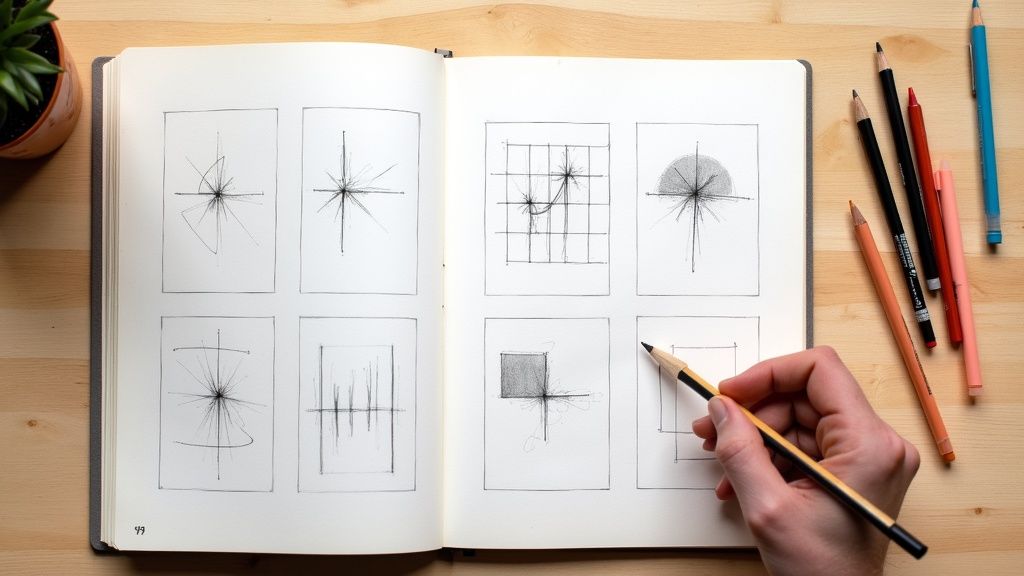
- Create texture sample sheets to experiment with different techniques and build a visual library.
- Practice blending different techniques, such as hatching and stippling, to create more complex textures.
- Start with simple textures and gradually progress to more intricate patterns.
This approach, employed by Renaissance masters known for their detailed texture work and continued by contemporary realist artists and architectural illustrators, elevates drawings from flat representations to lifelike depictions. It is a valuable exercise for any aspiring artist and a crucial element in this list of drawing ideas for beginners.
9. Gesture Drawing
Gesture drawing, a cornerstone for beginners, involves quick, loose sketches capturing the essence of movement and pose rather than fine details. Typically completed in 30 seconds to 5 minutes, these drawings train your eye to see the "big picture" and develop spontaneity, confidence, and a sense of dynamism in your work. This technique prioritizes capturing the underlying energy and flow of a subject, making it a valuable tool for improving observational skills.
Examples and Implementation
Gesture drawing applies to a wide range of subjects. Consider these examples: capturing the swift movement of a running animal, sketching dynamic action poses of athletes, or quickly depicting people in public spaces. Each scenario offers an opportunity to focus on the core flow of movement and gesture, ignoring details in favor of capturing the essential energy.
- 30-second figure poses are a classic exercise for practicing gesture drawing.
- Quick sketches of animals in motion refine your ability to depict dynamic poses.
- Observing and sketching people in public spaces sharpens real-world application.
Actionable Tips for Practice
Consistent practice is essential for mastering gesture drawing. Set aside short, timed sessions regularly. Use a large pad of inexpensive paper and a charcoal pencil or soft graphite for fluid strokes. Learn more about Gesture Drawing at this resource.
- Focus on the line of action first, the imaginary line that runs through the subject's pose.
- Use your whole arm, not just your wrist, for broader, more expressive lines.
- Prioritize capturing the largest shapes and forms first, then refine as time permits.
- Don't get bogged down in details; embrace imperfection and focus on capturing movement.
Popularized by artists like Kimon Nicolaides ("The Natural Way to Draw") and Glenn Vilppu, gesture drawing is a fundamental technique used extensively in animation studios like Disney and Pixar. Its effectiveness in developing observational skills and expressive line work makes it a valuable drawing idea for beginners, solidifying its place on this list.
9 Drawing Ideas Comparison Table
Item | Implementation Complexity | Resource Requirements | Expected Outcomes | Ideal Use Cases | Key Advantages |
|---|---|---|---|---|---|
Basic Shapes and Forms | Low | Minimal (paper, pencil) | Mastery of form, proportion, perspective | Foundational drawing skills, beginners | Essential base, quick confidence |
Still Life Drawing | Medium | Basic drawing tools, good lighting | Improved observation, shading, texture | Indoor controlled practice, detail focus | Stable subjects, teaches patience |
Simple Landscape Sketches | Low to Medium | Minimal, preferably outdoor | Understanding perspective, depth | Outdoor scenes, nature studies | Abundant subjects, creative freedom |
Basic Portrait Features | Medium | Basic drawing tools | Facial anatomy comprehension | Focused facial feature study | Manageable parts, precise practice |
Animal Sketches | Medium | Basic drawing tools | Animal anatomy and movement capture | Pets, wildlife quick studies | Engaging subjects, builds confidence |
Cartoon and Stylized Characters | Low | Minimal | Creative expression, character design | Stylized, fun, less realistic work | Encourages creativity, quick results |
Botanical Drawing | Medium to High | Quality tools recommended | Detailed plant study, precision | Scientific and detailed botanical art | Combines art and science |
Pattern and Texture Studies | Low | Minimal | Texture rendering skills, hand control | All realistic drawing applications | Quick practice, versatile skill |
Gesture Drawing | Low | Minimal | Capture movement and energy quickly | Figure drawing, action poses | Builds confidence, spontaneity |
Level Up Your Drawing Journey
This collection of drawing ideas for beginners provides a springboard for developing your artistic skills. From basic shapes and forms to dynamic gesture drawing, each prompt offers a unique opportunity to practice observation, technique, and creative expression. Remember the power of starting with simple objects and gradually increasing complexity. Mastering fundamental concepts like proportion and perspective in still life and landscapes translates directly into more challenging subjects like portraits and animals.
Building Your Skills Step by Step
By exploring various drawing ideas like botanical studies and pattern exercises, you'll refine your ability to capture detail and texture. Don't underestimate the value of experimenting with different styles, including cartooning and stylized characters. Each foray into a new area expands your visual vocabulary and strengthens your overall artistic foundation.
Embracing the Learning Process
One of the most crucial takeaways for beginners is the understanding that mistakes are inevitable, and more importantly, valuable. Every stroke, even the ones you might consider "wrong," contributes to your growth as an artist. Embrace the learning process, remain patient with yourself, and celebrate small victories along the way. Consistent practice combined with thoughtful exploration of different drawing ideas will undoubtedly lead to significant improvement.
The Importance of Continued Inspiration
As you progress, finding fresh drawing ideas for beginners can be challenging. Staying inspired and motivated is key to maintaining momentum in your artistic journey. This is where seeking out new sources of inspiration becomes invaluable. Exploring different techniques, subject matter, and artistic styles will keep your creative energy flowing and prevent stagnation.
Expanding Your Creative Horizons
Remember the foundational drawing ideas presented here:
- Basic Shapes and Forms: The building blocks of all drawing.
- Still Life Drawing: Practicing observation and accuracy.
- Simple Landscape Sketches: Capturing the essence of the natural world.
- Basic Portrait Features: Understanding facial proportions and expressions.
- Animal Sketches: Developing dynamic line work and capturing movement.
- Cartoon and Stylized Characters: Exploring creativity and exaggeration.
- Botanical Drawing: Honing detail and precision.
- Pattern and Texture Studies: Enhancing visual vocabulary.
- Gesture Drawing: Capturing the essence of motion and form.
These core skills provide a strong base for future artistic exploration. Continuously seeking new drawing ideas for beginners, even as your skills advance, will keep you challenged and engaged.
Looking for a constant stream of new drawing prompts to fuel your artistic growth? Explore Drawing List, the AI-powered idea generator designed to provide endless inspiration for artists of all levels. From specific subject matter requests to curated collections, Drawing List helps you find the perfect drawing ideas for beginners and beyond.