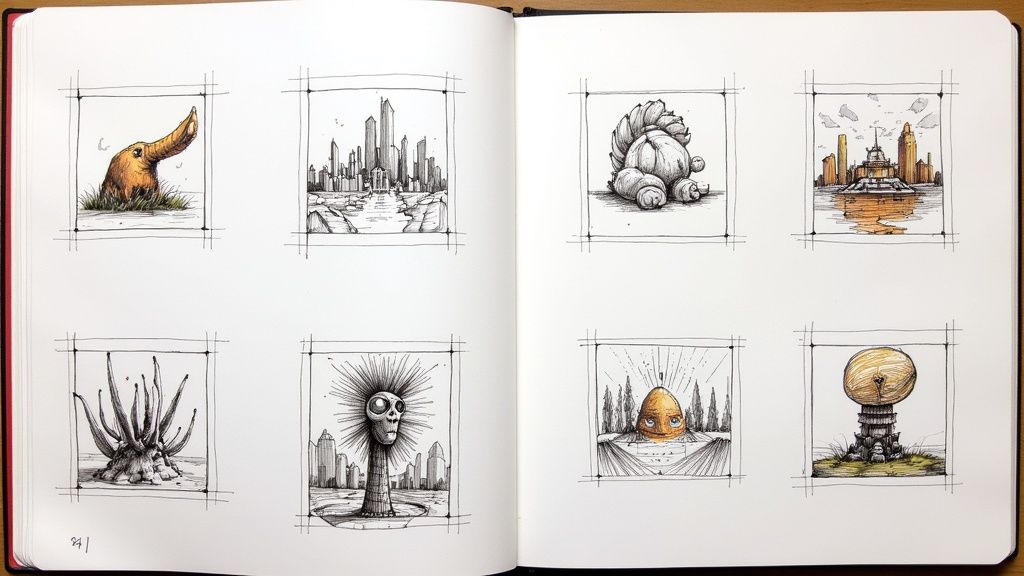
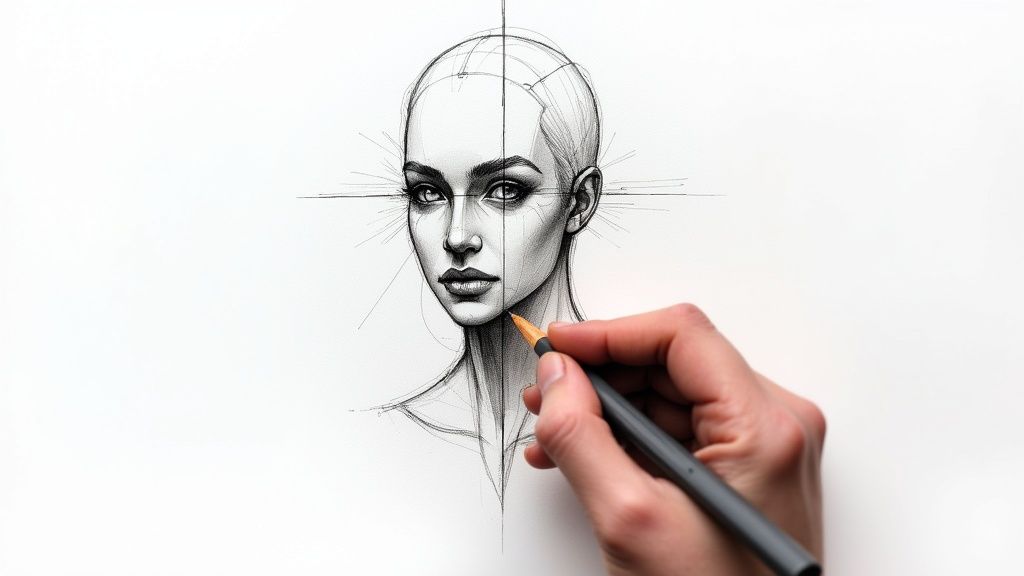
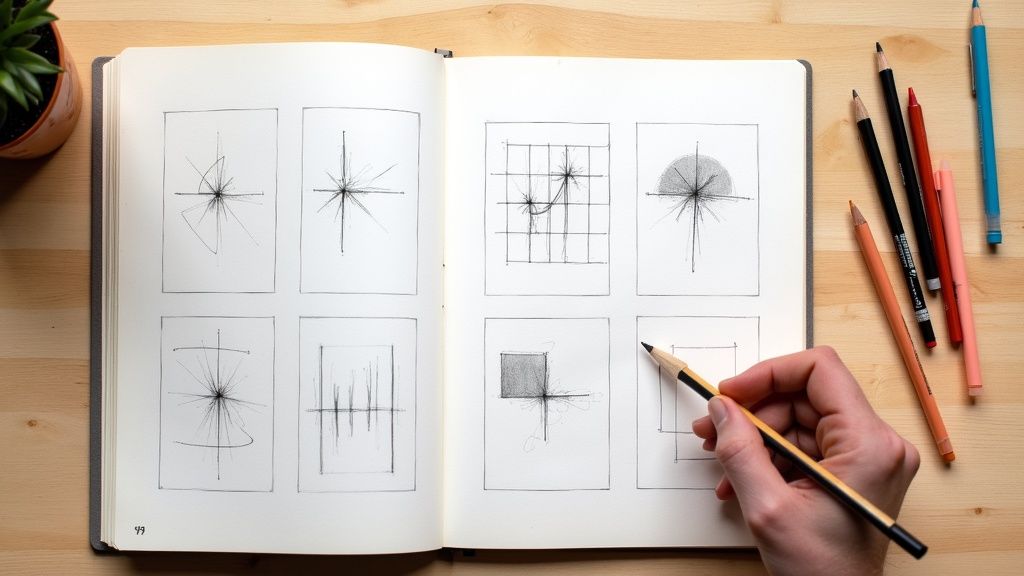
Every artist, from the seasoned professional to the weekend hobbyist, knows the feeling of staring at a blank page. The desire to create is strong, but the inspiration is nowhere to be found. This challenge, often called 'artist's block,' isn't a sign of failure but an opportunity to explore new creative territories. This comprehensive guide moves beyond generic prompts to offer a structured collection of powerful drawing ideas, each serving as a gateway to a different artistic discipline.
We have organized this listicle into ten distinct genres, providing a roadmap for targeted skill development and creative exploration. You will discover actionable prompts within each of the following areas:
- Portrait and Figure Drawing
- Landscape and Urban Sketching
- Still Life and Botanical Art
- Character Design and Animal Drawing
- Architectural and Abstract Concepts
For each category, we provide specific, actionable prompts and practical tips designed not just to fill your page, but also to build your technical skills, refine your unique style, and reignite your passion for making art. Whether you're looking to master human anatomy through figure drawing, capture the dynamic energy of a city, or simply find a fun way to spend an afternoon with a pencil, these drawing ideas will provide the spark you need. Consider this your definitive resource for overcoming the blank page and transforming it into a space of endless possibility. Let's dive in and find your next masterpiece.
1. Portrait Drawing
Portrait drawing is the timeless art of capturing a person's likeness and essence on paper. More than just replicating features, a successful portrait conveys the subject's personality, mood, and inner world. This discipline is a foundational practice for any artist, offering an endless wellspring of compelling drawing ideas that challenge your observational skills and emotional intelligence. From the classical self-portraits of Leonardo da Vinci to the hyper-realistic work of Chuck Close, portraiture remains a powerful way to connect with the human experience.
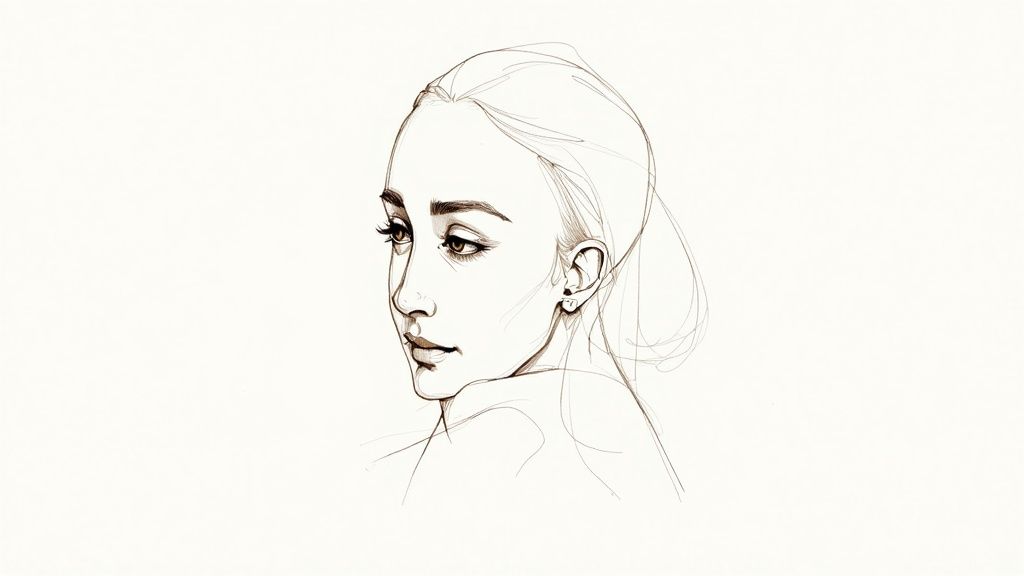
This practice is perfect when you want to develop a deeper understanding of anatomy, light, and texture. It forces you to move beyond simple lines and shapes to see the subtle planes of the face and the way light and shadow create form.
How to Get Started with Portraiture
To begin, focus on structure before detail. Many artists, like the influential Andrew Loomis, developed methods to simplify the head into basic geometric shapes. This approach helps establish accurate proportions before you start rendering individual features.
Pro Tip: When starting out, try drawing from live models whenever possible. Photos can flatten features and distort shadows, while drawing from life provides a richer understanding of form and dimension.
Actionable Tips for Better Portraits
- Master Proportions: Learn foundational guidelines for placing eyes, nose, and mouth. Typically, the eyes are halfway down the head, and the bottom of the nose is halfway between the eyes and the chin.
- Isolate and Practice: Dedicate entire practice sessions to drawing just one feature, such as eyes or mouths, from various angles. This repetition builds muscle memory and confidence.
- Use the Grid Method: For achieving a high degree of accuracy, especially from a photo reference, overlaying a grid on both your reference and your drawing surface can be incredibly effective.
- Capture Diverse Subjects: Make a conscious effort to draw people of different ages, ethnicities, and expressions. This expands your visual library and improves your ability to render unique features and skin textures.
2. Landscape Drawing
Landscape drawing is the artistic practice of depicting natural outdoor scenes, capturing the grandeur of mountains, the serenity of forests, or the vastness of the sky. Far beyond simply copying a view, a great landscape drawing communicates the mood of a place and the artist's emotional response to it. This genre provides a wealth of drawing ideas that sharpen your skills in composition, perspective, and rendering natural textures. From the dramatic works of J.M.W. Turner to the expressive countryside scenes of David Hockney, landscape art offers a profound connection to the world around us.

This practice is ideal when you want to explore composition and atmospheric perspective. It challenges you to create a sense of depth and distance on a flat surface, teaching you how to guide the viewer's eye through a scene using line, value, and detail.
How to Get Started with Landscapes
To begin, simplify the scene into large, basic shapes and values. Focus on establishing the composition by defining the foreground, middle ground, and background. This structural approach, often used by plein air artists, helps create a convincing illusion of depth before you get lost in rendering individual trees or rocks.
Pro Tip: Keep a portable sketching kit with you. Inspiration for a landscape can strike anywhere, from a city park to a mountain trail. Having a small sketchbook, a few pencils, and an eraser ready allows you to capture fleeting moments of light and weather.
Actionable Tips for Better Landscapes
- Layer for Depth: Use the concept of foreground, middle ground, and background to build your composition. Place darker, more detailed elements in the foreground and lighter, less detailed elements in the background to create atmospheric perspective.
- Study the Sky: The sky sets the mood for the entire scene. Dedicate practice time to drawing different cloud formations, from wispy cirrus to dramatic cumulonimbus, and study how light changes throughout the day.
- Simplify Complex Textures: Instead of drawing every single leaf on a tree, focus on suggesting the overall texture. Use varied marks, hatching, and scribbling to represent foliage, bark, or grassy fields.
- Use Compositional Guides: Employ principles like the rule of thirds to place your focal points. Avoid centering the horizon line; placing it in the upper or lower third of your drawing often creates a more dynamic and interesting image.
3. Still Life Drawing
Still life drawing is the art of depicting inanimate objects, arranged in a deliberate composition. It is a fundamental practice that teaches artists to see the world in terms of shape, form, texture, and the interplay of light and shadow. More than just drawing fruit in a bowl, a great still life tells a story and transforms mundane items into subjects of beauty. This discipline provides a rich source of drawing ideas, allowing you to control every element of your scene, from subject matter to lighting, making it an ideal training ground for honing your foundational skills.

This practice is perfect for artists who want to master composition, light, and texture in a controlled environment. Unlike drawing from life, your subjects won't move, giving you ample time to study relationships between objects, the subtlety of reflected light, and the accuracy of cast shadows. For those just starting out, exploring some simple still life drawing ideas on DrawingList.com can be an excellent entry point.
How to Get Started with Still Life
Begin by selecting a few simple objects with varied shapes and textures, such as a ceramic mug, a piece of fruit, and a crumpled piece of paper. Arrange them on a surface under a single, strong light source to create clear, defined shadows. This controlled setup simplifies the scene, allowing you to focus on rendering form and value accurately.
Pro Tip: Don't just place objects randomly. Think about creating a visual path for the viewer's eye. Use principles like the rule of thirds or leading lines to create a dynamic and engaging composition.
Actionable Tips for Better Still Life Drawings
- Use a Single Light Source: To start, illuminate your scene with one lamp or from one window. This creates distinct highlights and easily readable cast shadows, helping you understand how light defines form.
- Vary Your Textures: Intentionally choose objects with different surface qualities: something smooth like glass, something rough like bread, and something soft like fabric. This will challenge you to develop different mark-making techniques.
- Focus on Negative Space: Pay as much attention to the shapes and spaces between the objects as you do to the objects themselves. Drawing the negative space accurately is a classic trick to improve your overall proportions.
- Explore Different Viewpoints: Don’t always draw your arrangement from eye level. Get down low for a "worm's-eye view" or stand up high for a "bird's-eye view" to discover more interesting and dramatic compositions.
4. Figure Drawing
Figure drawing is the foundational study of the human form in its entirety, focusing on anatomy, proportion, and gesture. Unlike portraiture, which hones in on the face, figure drawing challenges artists to capture the body's dynamic movement, weight, and structure. It’s an essential practice that provides endless drawing ideas for anyone interested in character design, animation, or classical art. From the anatomical precision of Michelangelo to the fluid dancers of Edgar Degas, figure drawing is about understanding the human body as a vehicle for expression and life.

This discipline is invaluable when you need to convey authentic human movement and create believable characters. It teaches you to see beyond static outlines and understand the underlying mechanics of how the body bends, twists, and balances, making your drawings feel more alive.
How to Get Started with Figure Drawing
The best entry point is through gesture drawing. Before worrying about perfect anatomy or detail, focus on capturing the essence of a pose with quick, energetic lines. These rapid sketches, often lasting only 30 seconds to two minutes, train your hand and eye to identify the flow and energy of the human form. This approach builds a strong foundation for more detailed and prolonged studies.
Pro Tip: Attend a life drawing session if possible. Drawing from a live model provides a three-dimensional understanding of form, foreshortening, and weight that is difficult to grasp from photographs alone. Many local art centers and colleges offer drop-in classes.
Actionable Tips for Better Figure Drawing
- Begin with Gesture: Always start with a “line of action,” a single, expressive curve that runs through the pose from head to toe. Build the rest of your drawing around this foundational line to ensure a dynamic result.
- Use Head Units for Proportion: A common technique is to use the height of the head as a unit of measurement. An average adult figure is typically 7.5 to 8 heads tall. This helps keep your proportions accurate.
- Study Basic Anatomy: You don’t need a medical degree, but learning the major muscle groups and skeletal landmarks will dramatically improve your ability to draw the figure from imagination.
- Find Compelling Poses: If you lack a live model, use online resources for inspiration. For a deeper dive into dynamic positions, explore different pose ideas for drawing.
5. Botanical Drawing
Botanical drawing is the art of illustrating plants, flowers, and fungi with both scientific precision and artistic grace. This discipline goes beyond simply sketching a flower; it involves a deep observation of a plant's structure, texture, and life cycle. It’s an excellent source of drawing ideas that hones your patience and attention to detail. From the pioneering work of Maria Sibylla Merian, who intricately documented plant and insect life, to the famous rose illustrations of Pierre-Joseph Redouté, botanical art is a beautiful marriage of science and aesthetics.
This practice is ideal when you want to refine your line work, study organic forms, and develop a subtle understanding of color and texture. It teaches you to look closer and appreciate the intricate designs found in the natural world, from the veins of a leaf to the delicate curl of a petal.
How to Get Started with Botanical Drawing
Begin by selecting a simple specimen, like a single leaf or a basic flower such as a daisy or tulip. Before you draw, spend time observing it from all angles. Note how the stem connects to the flower, the pattern of the leaves, and the way light interacts with its surfaces. This preliminary study is crucial for creating an accurate and lifelike illustration.
Pro Tip: Using a magnifying glass can be a game-changer. It reveals the tiny, intricate details that are often missed by the naked eye, such as the fine hairs on a stem or the complex texture of a seed pod, adding incredible realism to your work.
Actionable Tips for Better Botanicals
- Study Plant Anatomy: Learn the basic parts of a plant (petal, sepal, stamen, pistil). Understanding the structure will make your drawings more accurate and believable.
- Work from Live Specimens: Whenever possible, draw from a real plant rather than a photograph. This allows you to see the true colors, textures, and three-dimensional form.
- Practice Individual Elements: Dedicate sketch sessions to drawing just leaves, then just petals, then just stems. Master each component individually to improve your overall compositions.
- Focus on the Life Cycle: Expand your drawing ideas by illustrating the different stages of a plant's life, from a small bud to a full bloom and eventually a wilting flower or seed head. This tells a more complete story.
6. Urban Sketching
Urban sketching is the vibrant practice of drawing on location in cities, towns, and villages. It's about capturing the energy of a place directly in your sketchbook, documenting daily life, architecture, and people as they are. More than just technical drawing, urban sketching is a form of visual journalism that tells the story of a specific time and place. This approach provides a wealth of drawing ideas, turning every street corner, café, and park into a potential subject. From the bustling cityscapes captured by the global Urban Sketchers community to the detailed architectural studies of professionals, this practice connects you intimately with your environment.
This practice is perfect when you want to improve your observational skills, speed, and confidence in drawing from life. It encourages you to embrace imperfection and focus on capturing the feeling and essence of a scene rather than getting lost in minute details.
How to Get Started with Urban Sketching
To begin, create a small, portable sketching kit. A simple setup might include a sketchbook, a few pens of different line weights, and a small watercolor set or some markers. The key is mobility. Start by finding a comfortable spot and drawing a single, interesting building or object. Focus on its main shapes and forms before adding smaller details.
Pro Tip: Don't wait for the "perfect" scene. The goal of urban sketching is to document life as it happens. A cluttered alleyway, a quiet bus stop, or a busy market all have unique stories to tell. Draw what you see, not what you think you should see.
Actionable Tips for Better Urban Sketches
- Establish a Focal Point: Decide what the most important element of your scene is and give it the most detail and focus. Let other elements be simpler to guide the viewer's eye.
- Simplify Complex Scenes: You don't have to draw every single brick or leaf. Use suggestive lines, textures, and value shifts to indicate detail without rendering it completely.
- Incorporate People and Movement: Adding figures, even simple gestural ones, can bring a static architectural scene to life. Capture the flow of pedestrians or the posture of someone waiting for a train.
- Join a Community: Look for a local Urban Sketchers group. Drawing with others is a fantastic way to stay motivated, discover new locations, and learn from fellow artists. Learn more about the essentials of Urban Sketching to get started.
7. Character Design
Character design is the imaginative process of inventing a visual identity for a fictional being. It's about more than just drawing a person or creature; it's about crafting a personality, backstory, and purpose into a single, cohesive visual. This is a core discipline in animation, video games, and comics, providing endless drawing ideas that blend storytelling with artistic skill. From the expressive designs of Glen Keane at Disney to the iconic creations of Hayao Miyazaki, character design is where visual art meets narrative.
This practice is perfect when you want to explore how form communicates function and personality. It challenges you to think like a storyteller, making deliberate choices about shapes, colors, and attire that reveal who your character is without a single word of dialogue.
How to Get Started with Character Design
Begin by exploring simple shapes and silhouettes. A character's core identity can often be communicated through their basic outline. Legendary animators like Chuck Jones proved that a strong, recognizable silhouette is the foundation of a memorable character. Focus on establishing this powerful visual read before getting lost in the smaller details.
Pro Tip: Before you draw a single line, write a short bio for your character. What is their main goal? What are their key personality traits (e.g., brave, shy, mischievous)? Answering these questions will guide your design choices and make your character more believable.
Actionable Tips for Better Characters
- Build from Shapes: Start with basic geometric shapes (circles, squares, triangles) to define the body and head. Circles often feel friendly and approachable, squares feel sturdy and reliable, and triangles can convey dynamism or villainy.
- Focus on Expression: Practice drawing your character with a wide range of emotions. Create expression sheets showing them as happy, sad, angry, and surprised. This ensures your design is versatile enough for storytelling.
- Study the Greats: Analyze the work of artists you admire, like Aaron Blaise or Claire Wendling. Break down why their designs are effective. Look at how they use shape language, color, and costuming to tell a story.
- Consider the Context: Design with the character's world in mind. A sci-fi hero from a technologically advanced society will look very different from a fantasy knight living in a medieval kingdom. Their environment should influence their clothing, gear, and even their posture.
8. Abstract Drawing
Abstract drawing is the liberating practice of creating art without depicting recognizable objects or scenes. Instead of representing the visible world, it uses shapes, lines, colors, and textures to convey emotions, concepts, and pure aesthetic feeling. This approach offers some of the most freeing drawing ideas, as it detaches you from the pressure of achieving a perfect likeness. From Wassily Kandinsky’s pioneering compositions to Julie Mehretu’s dynamic, layered works, abstract art prioritizes internal expression over external reality.
This practice is ideal when you feel creatively stuck or want to focus on the fundamental elements of art itself. It encourages you to explore composition, balance, rhythm, and mark-making in a raw and intuitive way, strengthening your overall artistic voice.
How to Get Started with Abstract Drawing
To begin, release the need for a final image. Start by making simple, intuitive marks on the page. Let your hand move freely, responding to a piece of music, a specific emotion, or just the physical sensation of the drawing tool on the paper. The goal is exploration, not representation.
Pro Tip: Set a timer for a short duration, like 5 or 10 minutes, and draw without stopping. This "automatic drawing" technique helps bypass your inner critic and unlocks more subconscious and spontaneous marks.
Actionable Tips for Better Abstract Drawings
- Limit Your Palette: Start with a limited set of tools or colors, such as just a black pen and a grey marker. Constraints often force more creative solutions and lead to a more cohesive composition.
- Focus on Composition: Pay close attention to how your marks and shapes are arranged. Consider principles like balance, contrast, and movement. Does your composition feel heavy on one side? Do your lines lead the viewer's eye around the page?
- Let Emotions Guide You: Choose an emotion, like joy, anger, or tranquility, and try to express it visually. Use fast, jagged lines for anger or soft, flowing curves for peace. This connects your physical actions to your inner state.
- Experiment with Tools: Go beyond traditional pens and pencils. Try using ink with a stick, charcoal on its side, or even non-art tools to create unique textures and marks you couldn't otherwise achieve.
9. Animal Drawing
Animal drawing is the captivating practice of depicting creatures from across the animal kingdom, from domestic pets to exotic wildlife. More than just sketching a furry friend, this discipline involves understanding unique anatomies, capturing dynamic poses, and conveying the distinct personality of each subject. It's a rich source of drawing ideas that hones observational skills and challenges you to portray texture, movement, and life. From the intricate studies of Albrecht Dürer to the iconic bird illustrations of John James Audubon, drawing animals is a timeless way to connect with the natural world.
This practice is perfect when you want to explore diverse forms, textures, and behaviors. It pushes you to master subjects that won’t sit still, forcing you to develop skills in gesture drawing, anatomical understanding, and quick sketching to capture fleeting moments.
How to Get Started with Animal Drawing
To begin, simplify complex animal bodies into basic geometric shapes like circles, ovals, and cylinders. This "construction" method helps you establish correct proportions and dynamic poses before you get lost in the details of fur, scales, or feathers. Focus on the overall gesture and flow of the animal first.
Pro Tip: Spend time at a local zoo, farm, or even a dog park with a sketchbook. Observing animals directly teaches you far more about their movement, posture, and behavior than a static photograph ever could. Quick gesture sketches are key.
Actionable Tips for Better Animal Drawings
- Study the Skeleton: Understanding the underlying bone structure of an animal is the secret to drawing it convincingly from any angle. It helps you understand how limbs bend and where muscles attach.
- Start with Your Pets: Domestic animals are excellent subjects because they are accessible. You can study them at rest and in motion, giving you ample opportunity to practice without pressure.
- Focus on the Eyes: The eyes are critical for conveying an animal's personality and mood. Pay close attention to reflections, pupil shape, and the surrounding expression to bring your subject to life.
- Capture Textural Variety: Challenge yourself to render different textures, from the sleek fur of a cat to the rough hide of a rhinoceros or the complex pattern of a bird's feathers. This builds a versatile skill set.
10. Architectural Drawing
Architectural drawing is the technical and artistic representation of buildings and structures. It masterfully blends precise drafting skills with creative vision to document, plan, or simply celebrate architectural forms. This discipline provides a rich source of drawing ideas that challenge your understanding of perspective, line weight, and spatial relationships. From the dramatic, imagined prisons of Giovanni Battista Piranesi to the futuristic sketches of Zaha Hadid, architectural drawing is a powerful way to explore both real and imagined worlds.
This practice is ideal when you want to sharpen your technical skills and create drawings with a strong sense of structure and realism. It trains your eye to see the geometry in the world around you and translate complex three-dimensional forms onto a two-dimensional surface with accuracy and style.
How to Get Started with Architectural Drawing
Begin by mastering the fundamentals of perspective. Understanding one-point, two-point, and even three-point perspective is non-negotiable for creating believable structures. Start by drawing simple cubes and rectangular prisms from different angles before moving on to more complex buildings and details.
Pro Tip: Use proper drafting tools to your advantage. A T-square, triangles, and a range of technical pens or graphite pencils can help you achieve the clean, precise lines that are characteristic of this style. Don't be afraid to use a ruler; it's a tool, not a crutch.
Actionable Tips for Better Architectural Drawings
- Master Perspective: Dedicate significant time to practicing one and two-point perspective. This is the absolute foundation for all architectural work.
- Study the Greats: Analyze the work of architects and architectural illustrators like Hugh Ferriss or Santiago Calatrava. Pay attention to how they use light, shadow, and line weight to create mood and emphasize form.
- Practice Your Linework: Fill pages with exercises for drawing straight, confident lines without a ruler. Also, practice varying your line weight to suggest depth; use thicker lines for objects that are closer to the viewer.
- Start with Simple Subjects: Don't try to draw a Gothic cathedral on your first day. Begin with a simple house, a shed, or even just a single doorway or window to build your confidence and skills.
10 Drawing Styles Comparison Matrix
Drawing Type | Implementation Complexity | Resource Requirements | Expected Outcomes | Ideal Use Cases | Key Advantages |
|---|---|---|---|---|---|
Portrait Drawing | High (requires anatomy, proportions) | Minimal supplies, good models | Accurate likeness, emotional expression | Commissions, character depiction | Develops observational skills, marketable |
Landscape Drawing | Moderate to High (perspective, composition) | Portable kit, outdoor accessibility | Depth and atmosphere, nature scenes | Outdoor sketching, nature studies | Connects with nature, improves perspective |
Still Life Drawing | Moderate (controlled setup, lighting) | Indoor setup, stable objects | Detailed study of form, volume, texture | Art fundamentals, practice sessions | Controlled environment, good for learning basics |
Figure Drawing | High (complex anatomy, movement) | Access to live models or references | Dynamic human form, anatomy understanding | Animation, illustration, fine arts | Fundamental skill, improves anatomy knowledge |
Botanical Drawing | High (scientific accuracy, detail) | Specialized tools, live specimens | Detailed plant morphology, scientific documentation | Scientific illustration, nature study | Combines art and science, meditative |
Urban Sketching | Moderate (quick, on-location) | Portable kit, public spaces | Spontaneous sketches, urban scenes | Travel journaling, environment study | Develops speed, visual diary, public drawing |
Character Design | High (creativity, anatomy, storytelling) | Digital and traditional tools | Unique, expressive characters | Animation, games, comics | Highly creative, strong entertainment market |
Abstract Drawing | Moderate (composition focus) | Basic art supplies | Emotional, conceptual art | Experimental, personal expression | Complete creative freedom, encourages experimentation |
Animal Drawing | High (anatomy, behavior knowledge) | Access to animals or photo references | Lifelike animal representations | Wildlife art, nature studies | Popular subject, texture practice |
Architectural Drawing | High (technical and artistic skills) | Drafting tools, precise instruments | Accurate building depictions | Architecture, design documentation | Technical skill, career opportunities |
From Idea to Masterpiece: Your Next Creative Steps
You've just navigated a comprehensive landscape of artistic possibilities, from the intricate lines of architectural drawing to the expressive freedom of abstract art. We've explored ten distinct domains, each a world of its own, brimming with potential drawing ideas. This journey through portraiture, landscapes, character design, and more wasn't just about presenting a menu of options; it was about showcasing the vast and exciting universe that awaits your creative touch. The core takeaway is that inspiration isn't a rare, mystical force. It's a muscle that grows stronger with use, and this list is your new workout routine.
The blank page can feel intimidating, a silent challenge to your creativity. But by breaking down the infinite possibilities into manageable categories like still life, botanical drawing, or urban sketching, that challenge transforms into an invitation. You are no longer facing an empty void; you are standing at the trailhead of ten unique and exciting paths. The true power of this guide lies not in just reading it, but in actively engaging with it.
Turning Inspiration into Action
The bridge between a good idea and a great drawing is built with consistent, intentional practice. The most successful artists don't wait for a lightning bolt of inspiration; they cultivate it daily. Here’s how you can translate the concepts we've covered into tangible progress and build a sustainable creative habit.
- Commit to a Single Focus: Instead of jumping randomly between genres, choose one area that truly sparked your interest. Did the dynamic energy of figure drawing catch your eye? Or perhaps the quiet, meditative process of animal drawing called to you? Dedicate a week, or even a month, to exploring that single subject. This focused approach allows for deeper learning and more significant skill development than scattered, superficial attempts.
- Establish a "Minimum Viable Sketch": Overcome the pressure to create a masterpiece every time. Set a small, achievable daily goal. This could be a five-minute contour drawing of a coffee mug (still life), a quick gesture sketch of a person on the bus (figure drawing), or a 15-minute study of a single leaf (botanical drawing). This habit demystifies the creative process and ensures you are always making marks, learning, and improving.
- Synthesize and Innovate: The true magic begins when you start combining these drawing ideas. Don't treat these categories as rigid boxes. What happens when you merge them?
- Character Design + Urban Sketching: Design a character who perfectly embodies the spirit of your favorite city street.
- Botanical Drawing + Portraiture: Create a portrait where a person’s hair is an intricate arrangement of flowers and vines.
- Architectural Drawing + Abstract Art: Take the structural lines of a famous building and deconstruct them into an abstract composition of shape and form.
By cross-pollinating ideas, you move beyond simple prompts and begin developing your unique artistic voice. This is the ultimate goal: not just to execute drawing ideas, but to generate your own.
The Value of the Journey
Every line you draw, whether it's a confident stroke in a finished piece or a hesitant mark in a quick study, is a step forward. This extensive list of drawing ideas serves as your map, but you are the explorer. Embrace the studies that don't work out; they teach you more about what to do differently next time. Cherish the sketches that surprise you; they are glimpses of your emerging style.
The goal isn't just to fill a sketchbook. It's to build a visual library in your mind, to sharpen your observation skills, and to develop the confidence to translate the world around you, and the worlds within you, onto the page. The path from a simple idea to a personal masterpiece is paved with practice, curiosity, and the courage to begin. The blank page is not an enemy; it is the ultimate field of opportunity. Go create something wonderful.
Never run out of inspiration again. For a limitless supply of unique prompts tailored to your interests, check out the generator at Drawing List. It's the perfect tool to keep your creative engine running and your sketchbook full of fresh drawing ideas. Visit Drawing List to discover your next prompt in seconds.